

Kids Beds Bunk
Bunk beds can add drama to kids' rooms, and they also provide them with an excitement. Ms. Keenan adds a shelf for books or a reading light in every sleeping nook to make bunk beds more attractive to children.
A lot of our bunk beds for kids can be made into two twin beds. This is a great option if your plan is to make them move to their own bedroom at some point. Pick from finishes like brushed white, gray and rich walnut.
Ladders and Stairs
You can choose between stairs or ladders when it comes to bunk beds for children. Ladders can be easily installed and are also less expensive. They also provide an easy way to climb into the top bunk bed. They are more secure than stairs, as they provide a wider area for children to walk on, and also have a handrail that is integrated. There are grooves on the steps to prevent slips when climbing up and down the bed.
If you like the design and look of stairs, they could be a more elegant addition for your bunk bed. Staircases are also suitable for rooms that are small on space, as they don't protrude into the room as ladders do. They are often made of wood or metal and can be a great match for various styles of bedrooms. Some staircases have integrated storage drawers that are an excellent way to expand the size of a bunk bed.
Another factor to consider when choosing between stairs and a ladder is the age of your child. While it is recommended nobody sleep on the top bunk below the age of 6, older children who are comfortable climbing vertically may be better off with stairs rather than a ladder. If you are planning to use your bunk bed for guests, such as younger children or adults who have limited mobility, it's best to use stairs.
A straight staircase on the side of the bed will require 95" of space on either side. If kids beds bunk do not have enough space, you can choose the u-shaped stairs that doesn't require as much space but still allows you to reach the top bunk in a safe and securely. Some beds come with the option of detaching the stairs when not being used, which reduces their footprint and makes them more versatile for rooms with multiple uses. You can also find stairs that connect to the bottom of the bed. This eliminates the need for separate handrails and makes it easier to climb up and down to the bottom for kids.
Guard Rails
Guard rails let children climb in and out of their beds on their own and provide them with a sense of freedom and confidence. They must be placed correctly to ensure that there aren't any gaps or loosening between the guardrails and the bed's frame. If you decide to install guard rails, follow the manufacturer's instructions and check them on a regular basis for any holes or looseness that could lead to the entrapment.
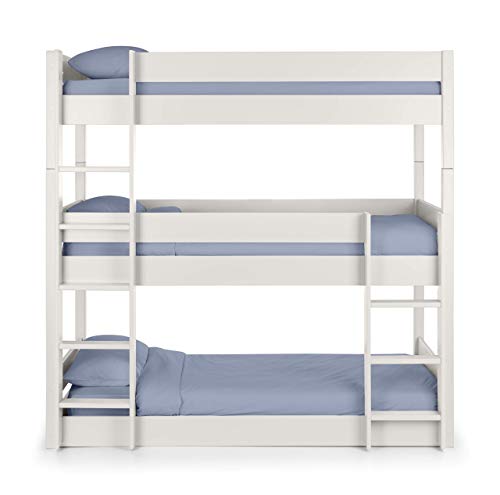
Keep bunk beds out of electrical appliances and other objects that can become projectiles while your children are playing or sleeping. Set bunk beds far from windows to avoid an injury to fall risk if your children get up on the upper floor.
You may want to install a nightlight on the ladder so that it can illuminate the steps up and down when your child awakes at night to use the bathroom, or if they are woken by a storm to leave their room.
A safety net could be installed at the top of the bunk to keep children from falling off while they sleep or play. This is especially a good idea for older children, who may be more likely to sleep on the top bunk.
Guardrails must be firmly attached to the bunk bed structure and not removed without the use tools. The guardrail openings that are above the mattress base should not exceed 3.5 inches wide to avoid strangulation or entrapment. Place the wedge block shown in Figure 1 in each of the openings in the topmost guardrail member and over the mattress foundation. Then apply 33-lbf (147-N) force in a direction perpendicular to the plane of the larger end of the block, and keep it there for 1 minute.
It's a good idea to tell your children not to hang any objects on the ladder or guardrail for example, belts, clothes, or sports equipment. Instead you should utilize an organized rack to keep these objects from becoming a strangulation hazard for your child. Make sure that no more than one child sleeps on the top bunk. This can lead to a risky imbalance and even falls.
Mattresses
When choosing a mattress to use for bunk beds, think about the size and age of your child. A bunk mattress will last for at least eight years, or until siblings are no longer sharing bedrooms So, you'll want to select a mattress designed to expand with your child and still provide sufficient support as they grow older.
There are many options for bunk mattress sizes. They are typically twin or full size. If your kiddos suffer from asthma or allergies choose an allergy-free mattress with dust mite barriers and a cover that wicks moisture. Mattresses that have an antimicrobial coating will protect the foam from harmful bacteria and germs.
Another crucial aspect to consider is the feel of your mattress. Kids generally weigh less than adults, so they require mattresses that feel firm but also comfortable. Many hybrid and latex mattresses come with an extra firm side as well as a soft side to meet children's requirements.
Memory foam mattresses be a great choice for children However, they're not our first choice as they can trap heat and may be too hard on young spines. Consider a hybrid or a latex mattress, which provides strong support and cooling infusions to your child or guests to rest comfortably.
Low-profile mattresses are often the ideal choice for bunk beds for children. These are designed to be smaller than standard mattresses and increase the height of the safety rails for the top bunk. They minimize "filler" materials to provide premium quality with a slim design.
Think about an innerspring model or a hybrid with upper comfort layers that can be removed and replaced as your child grows. These models will give you a good idea of how the mattress will perform as your child grows, and you can always put in the mattress pad or bed skirt to stop it from slipping off the frame. Some beds even have built-in lip or side rails to stop this from happening.
Storage
Bunk beds are an excellent option to free up space in shared kid rooms. They also can be a cost-effective alternative to purchasing two separate full sized single beds. Many bunks allow to add a trundle, which can be tucked under the bottom bunk when not being used.
Consider installing a kids bedroom furniture combination set that includes bookshelves, desks, or dressers to maximize storage and space in a room with bunk beds. This will allow you to keep all your child's clothing as well as toys and personal belongings in one spot instead of stuffing everything into overstuffed chests or closets. The sets of kids bedroom furniture are sold at a variety of retailers. kids beds bunk are safe to use and meet federal standards.
The stacking bunks provide a playground for imagination and children can transform the spaces below into secret hideaways or cosy play areas. Designer Elizabeth Georgantas stacked 6 bunks in this room to create the ultimate kids space that can be used for sleeping, playing and even superhero cape twirls. The room has bubble walls covered with Chasing Paper and a ceiling painted in Benjamin Moore Blue Jean to create the ultimate escape.
If you are unable to install stairs to your bunk that is stacked A ladder is an easy solution. They are constructed with a single socket Flange, Single Socket Degree Side Outlet Fittings. They can be easily adjusted to increase or decrease the distance between ladder rungs. The ladder rungs can also be positioned directly on the ground rather than higher to aid in climbing.
Installing loft beds that can be lowered to just above the ground is another way to maximize the space in the bunk bedroom. This lets you slide desks, dressers and toy chests right under the beds. This is a great way to maximize the space in smaller bedrooms or in large family homes where beds must be sufficient for multiple people to sleep.